
Python configparser 怎样区分缺失节和缺失选项
来源:17golang原创
时间:2026-10-27 00:09:43 432浏览 收藏
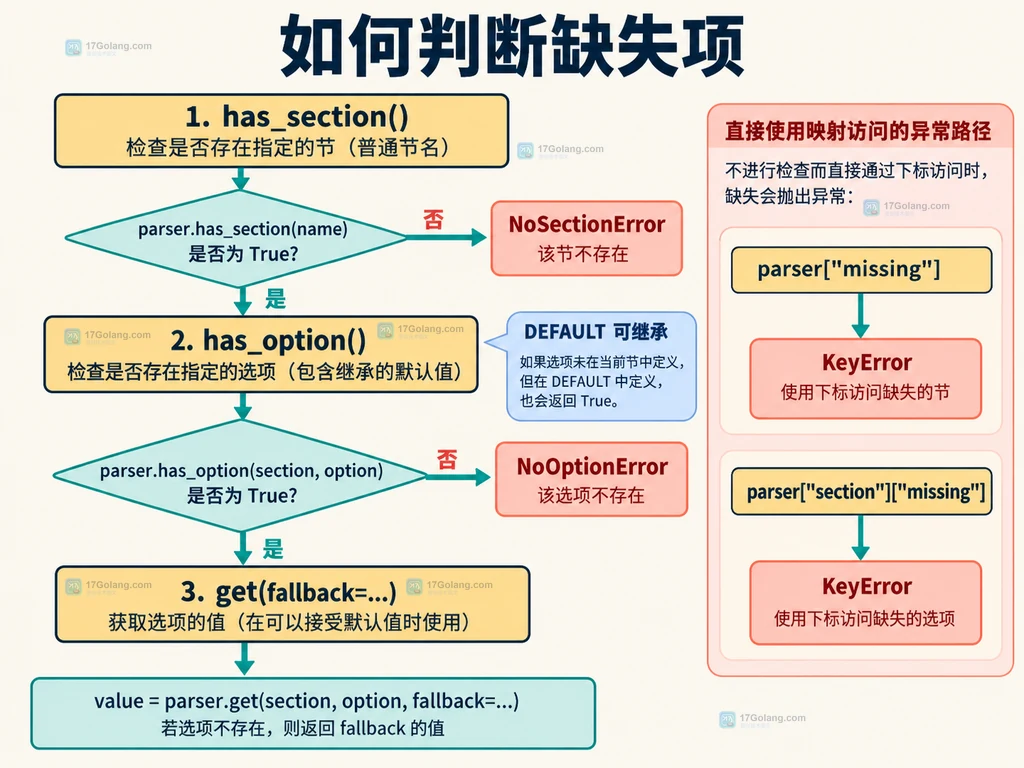
Python 的 configparser 读取 INI 配置时,缺失 section 和缺失 option 应该分开判断:先用 has_section() 判断普通节是否存在,再用 has_option() 判断节中的选项是否可用;如果配置项允许缺省,就用 get(..., fallback=...) 提供默认值。直接使用映射下标时,两类问题通常都会表现为 KeyError,不利于区分原因。
官方文档:https://docs.python.org/3.14/library/configparser.html
先分清 section、option 和 DEFAULT
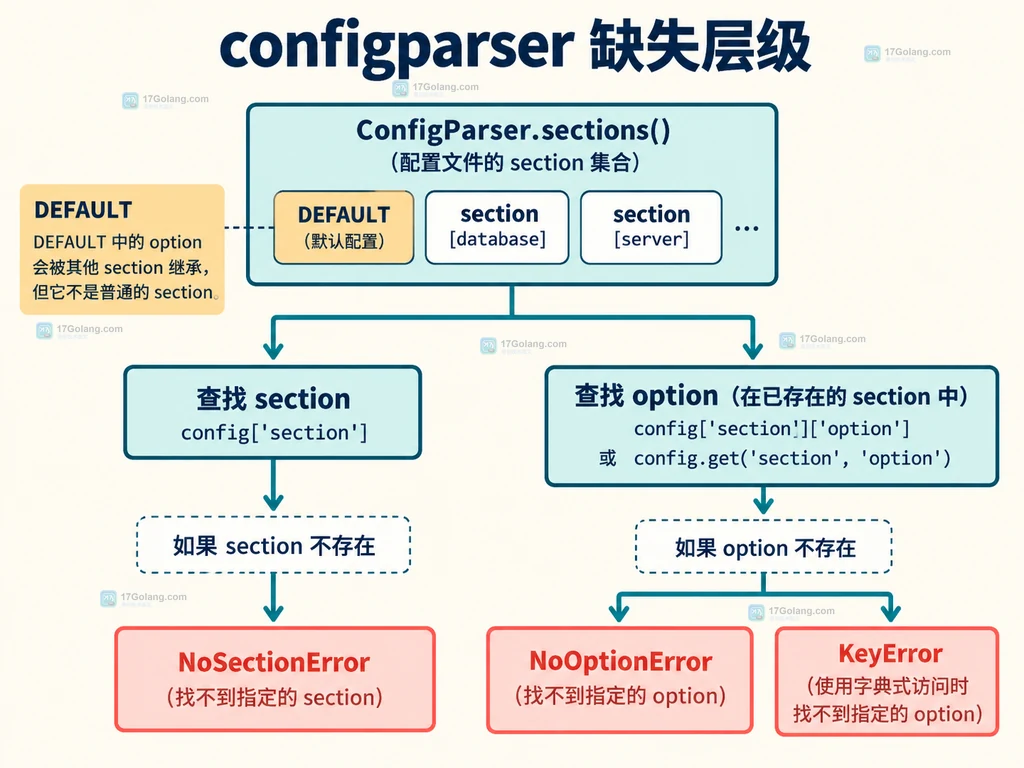
一个 INI 配置可以看成三层关系:解析器包含多个普通 section,section 里面包含 option,DEFAULT 则为其他 section 提供默认值。sections() 返回普通 section 列表,但不会把默认节放进列表;因此不能因为看不到 DEFAULT 就认为默认值不存在。
; DEFAULT 为普通 section 提供可继承的默认值
[DEFAULT]
timeout = 30

[server]
host = 127.0.0.1
上面的配置中,server 是普通 section,host 是显式 option,timeout 是从 DEFAULT 继承到 server 的可用 option。
用 has_section 判断缺失 section
当 section 名称来自环境变量、租户配置或命令行参数时,先调用 has_section()。它只确认普通 section,特殊的 DEFAULT 不会被它当成普通节确认。
import configparser

config = configparser.ConfigParser()
config.read_string("""
[server]
host = 127.0.0.1
""")

section_name = "worker"

# 先判断普通 section,避免把“节不存在”误判成“选项不存在”。
if not config.has_section(section_name):
    print(f"缺少 section: {section_name}")
else:
    print("section 已存在")
如果继续调用解析器级别的 get(section, option),缺失 section 会抛出 NoSectionError;这是“容器层不存在”,不是某个 option 拼写错误。
用 has_option 判断缺失 option
确认 section 存在后,再判断 option。has_option(section, option) 会判断该 section 能否取得该选项;默认值也参与选项查找,所以继承自 DEFAULT 的配置项可能返回 True。
import configparser

config = configparser.ConfigParser({"timeout": "30"})
config.read_string("""
[server]
host = 127.0.0.1
""")

if config.has_section("server"):
    # DEFAULT 中的 timeout 对 server 可见,因此这里可以取得它。
    if config.has_option("server", "timeout"):
        timeout = config.getint("server", "timeout")
        print(f"timeout={timeout}")

    # 这个名字既不在 server,也不在 DEFAULT 中。
    if not config.has_option("server", "port"):
        print("server.port 未配置")
如果直接使用 config.get("server", "port"),缺失 option 会抛出 NoOptionError。如果该配置是可选项,可以把读取写成 config.get("server", "port", fallback="8080"),让缺省值成为明确的业务策略。
映射下标为什么更容易只看到 KeyError
ConfigParser 支持类似字典的访问方式,但下标访问的异常粒度更粗:config["missing"] 是缺少 section,config["server"]["port"] 是缺少 option,调用方都可能只拿到 KeyError。需要区分错误类型时,优先使用显式检查或经典 API。
import configparser

config = configparser.ConfigParser()
config.read_string("[server]\nhost = 127.0.0.1\n")

try:
    # 显式捕获 section 缺失,错误信息更接近配置问题本身。
    host = config.get("worker", "host")
except configparser.NoSectionError as exc:
    print(f"配置节不存在: {exc.section}")

try:
    # section 存在,但 option 缺失时进入这个分支。
    port = config.get("server", "port")
except configparser.NoOptionError as exc:
    print(f"配置项不存在: {exc.option}")
必填配置适合抛出或转换为启动错误;可选配置适合使用 fallback。不要为了省一行代码把所有读取都包成一个 except KeyError,否则后续很难判断应该补 section 还是补 option。
一套可复用的判断顺序
| 场景 | 推荐方式 | 结果 |
|---|---|---|
| 必须存在某个普通 section | has_section(name) | 不存在时给出 section 级错误 |
| section 存在但 option 可选 | get(section, option, fallback=value) | 缺失时使用业务默认值 |
| 需要确认 option 是否含 DEFAULT 继承 | has_option(section, option) | 按解析器实际可取得的值判断 |
| 必填配置需要精确报错 | 捕获 NoSectionError / NoOptionError | 区分容器缺失和字段缺失 |
常见问题
has_section("DEFAULT") 为什么是 False?
因为 DEFAULT 是默认值容器,不是 sections() 返回的普通 section。要检查默认配置内容,可以使用 defaults() 或直接通过其他 section 读取继承值。
has_option() 为 True 就代表 option 写在当前 section 吗?
不一定。它表示该 option 对指定 section 可用,也可能来自 DEFAULT。如果业务必须知道配置是否显式写在当前节,还要结合 config._sections 之外的自有解析规则,避免依赖内部属性。
什么时候应该使用 fallback?
只有当缺失值确实有稳定、安全的业务默认值时才使用。数据库地址、鉴权信息等必填配置不应悄悄回退到一个可能误导排障的值。
-
276 收藏
-
339 收藏
-
435 收藏
-
485 收藏
-
346 收藏
-
434 收藏
-
271 收藏
-
151 收藏
-
429 收藏
-
130 收藏
-
259 收藏
-
291 收藏
-
188 收藏
-
156 收藏
-
359 收藏
-
文章 · python教程 | 1小时前 | python · logging · Python logging.handlers.MemoryHandler 日志缓冲 批量刷新 flushLevel181 收藏
-
262 收藏
-

- 前端进阶之JavaScript设计模式
- 设计模式是开发人员在软件开发过程中面临一般问题时的解决方案,代表了最佳的实践。本课程的主打内容包括JS常见设计模式以及具体应用场景,打造一站式知识长龙服务,适合有JS基础的同学学习。
- 立即学习 543次学习
-

- GO语言核心编程课程
- 本课程采用真实案例,全面具体可落地,从理论到实践,一步一步将GO核心编程技术、编程思想、底层实现融会贯通,使学习者贴近时代脉搏,做IT互联网时代的弄潮儿。
- 立即学习 516次学习
-

- 简单聊聊mysql8与网络通信
- 如有问题加微信:Le-studyg;在课程中,我们将首先介绍MySQL8的新特性,包括性能优化、安全增强、新数据类型等,帮助学生快速熟悉MySQL8的最新功能。接着,我们将深入解析MySQL的网络通信机制,包括协议、连接管理、数据传输等,让
- 立即学习 500次学习
-
- JavaScript正则表达式基础与实战
- 在任何一门编程语言中,正则表达式,都是一项重要的知识,它提供了高效的字符串匹配与捕获机制,可以极大的简化程序设计。
- 立即学习 487次学习
-

- 从零制作响应式网站—Grid布局
- 本系列教程将展示从零制作一个假想的网络科技公司官网,分为导航,轮播,关于我们,成功案例,服务流程,团队介绍,数据部分,公司动态,底部信息等内容区块。网站整体采用CSSGrid布局,支持响应式,有流畅过渡和展现动画。
- 立即学习 485次学习